I have been around metalworking and the guys who do it for many years, in fact for most of my life. When I was young I learned to build ships out of steel and aluminum. In those days I was a shipfitter, and my primary tool was a cutting torch. Today, a retired engineer, I still like to make things out of steel. Sometimes I run across someone who needs to get rid of some steel quickly. That happened a few years ago, and one of the pieces I got was most of a 4x8' sheet of 3/8" steel plate. That tips the scale at well over 400 pounds. At my age, that makes it unthinkable to move it by hand. So I use a plate dolly I built, my overhead gantry which I also built, and my shop crane which I rebuilt.
As I write this my current project is restoring an elderly hydraulic press which spent its working life in an old school gas station. The press weighs quite a bit too, and it's very unwieldy to move. So I needed to put it on wheels. I decided to use some of my 3/8" plate to make a rolling base. And, while I was at it, I decided to cut more pieces of that same plate to fit onto the press table, which makes it a lot more convenient to have around. With some difficulty, I got the big plate up on sawhorses under my gantry, and cut off a rectangle the right size. I was not happy with the way the heavy plate sat on my Home Depot steel sawhorses. Nothing actually fell over, but it sure didn't feel safe. Also, I had to wait until Seattle's spring rains stopped. I've never done much torch work inside my shop (out of the weather) because I didn't want to deal with the fire risk or the mess of having all that molten steel spattered everywhere. So I designed a way to cut plate safely and cleanly inside my shop. I'd like to share this method with you.
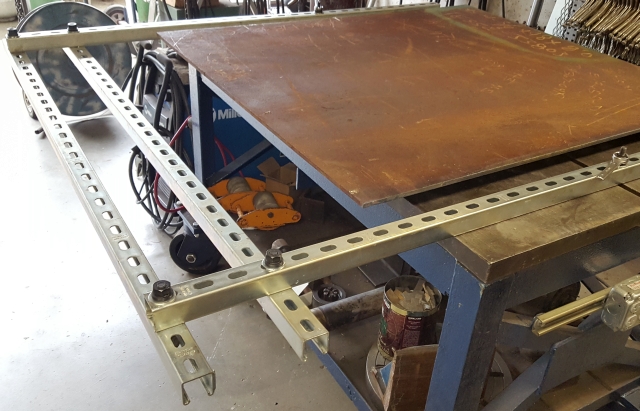
My problem was how to hold a steel workpiece for cutting inside. It's not so bad to have to hold a piece of plate. But to cut a big piece of it and have that piece stay put and not go crashing on the floor or into something is more difficult. In the first picture below, you can see the general arrangement I came up with. I cut four pieces of 1-5/8" strut each 60" long. With those pieces and some bits from my mill's clamping kit I came up with this:
I have a heavily built welding table. I figure it weighs about a ton. The top has one tee slot in each direction. In the picture above I used the tee nuts to fasten the table to the bottom of a pair of outriggers. Outboard of the table are the other two pieces of strut which form a frame which holds up the piece being cut off the plate. The plate itself just sits on the table. In the next picture you can see everything in place for the cutting job.
I cut plate with a track burner. I ran a track burner for quite a few shifts back in the '70s, and find them easy and intuitive to run, as well as a lot of fun. They cut a beautiful straight line, too. Very satisfying. This track burner is an old Victor model. I think Victor bought the design from Heath Engineering. Anyway, it's a clever design and I will probably be writing a blog just about that track burner soon.
Back to cutting plate. Here's the picture I promised you:
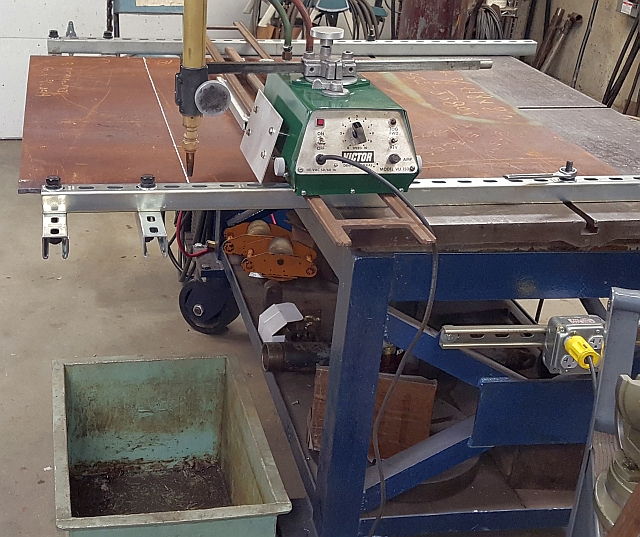
Note how the piece to be cut off is centered on the two pieces of strut that form a support frame below the cutoff piece. After the cut is complete, the free piece won't go anywhere because it is solidly supported. The plate won't go anywhere either because its center of gravity is up on the table. Also, notice that the machine torch's track lies across the two outrigger struts. You can't really see it, but I blocked the track up so it was nice and stable all the way along its length. Otherwise it would have been like a trampoline!
Remember I said the other piece of the problem was containing the sparks? Don't want things catching on fire and I don't want all that burning slag everywhere. See the green metal box at the bottom left of the picture above? It is on casters. It's made of aluminum The slag will have less of a tendency to stick to aluminum. As the track burner moves, I just move the green box along with it.
The next picture shows the cut actually in progress:
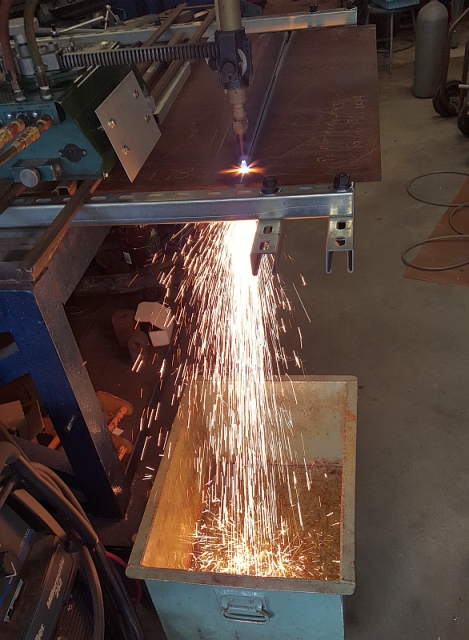
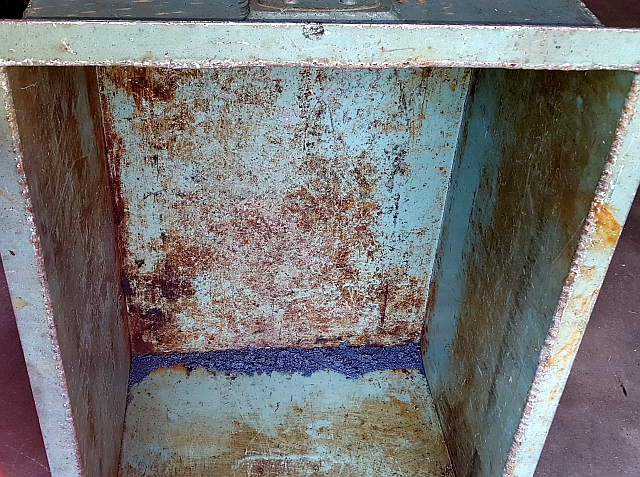
You can see the sparks are nearly all going into the box. When I'm all done cutting, I can just dump the (cooled off) slag into the trash. The box, being aluminum, is light. I like that little box. It came from the old Boeing Surplus which is a place I miss greatly. After this cut I didn't have to sweep the floor - the slag was essentially all in the box. See:
So that's pretty much it. I figured out an easy-to-assemble easy-to-store track burner setup that holds both the host material and the workpiece cut from it safely. And how I can do the cut inside without waiting for the rain to stop, and without making a mess.
Thanks for reading!